ERP software pricing comparison: build a like-for-like ledger
Compare ERP proposals using a common scope, license map, delivery plan, and budget horizon instead of a single advertised monthly price.
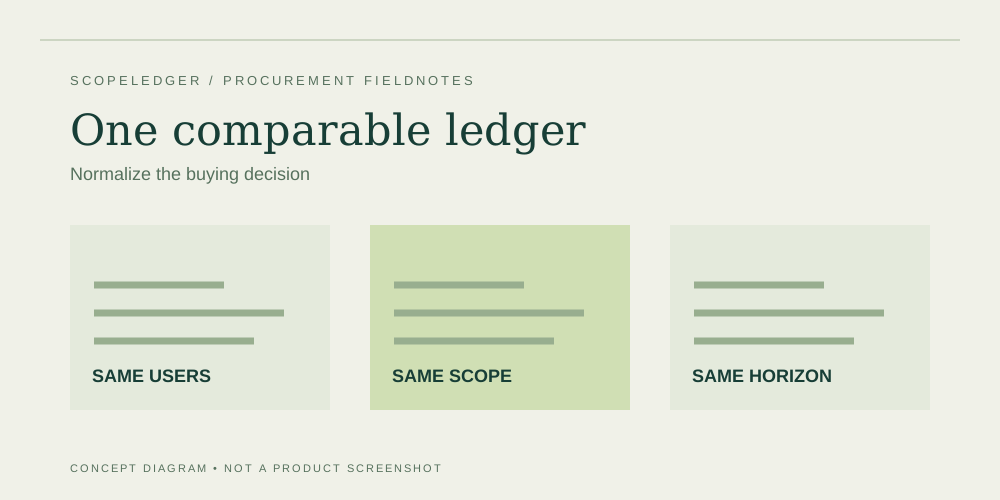
The useful ERP price is the cost of delivering your required workflows over an agreed period. Compare proposals on the same users, entities, modules, implementation deliverables, and recurring operations. A subscription price alone cannot tell you which proposal has the lower total cost. Start with a scope ledger: one row for every requirement, its price basis, its owner, and the evidence that it is included.
Begin with the decision, not the product list
Write down why the organization is considering a replacement. Slow closing, fragmented inventory records, and an unsupported legacy integration imply different requirements. Describe the observable result rather than writing “modern ERP.” For a month-end close, that might mean reconciling subledgers to the general ledger with an agreed exception report. For distribution, it might mean tracing a receipt through put-away, reservation, shipment, and invoicing. Give each required workflow an owner who can approve a test.
Set the comparison boundary before demonstrations begin. Decide whether payroll, ecommerce, manufacturing, field service, and business intelligence are inside the project or interfaces to existing systems. A vendor that excludes payroll should not look cheaper merely because another includes it. Keep future possibilities in a separate optional scope so they do not silently inflate the initial purchase.
Put proposals on one basis
| Ledger line | What to record | Evidence to request |
|---|---|---|
| Subscription | User role, tier, billing cadence | Order form and entitlement description |
| Delivery | Configuration, migration, training | Statement of work and exclusions |
| Integration | Build, hosting, monitoring, changes | Interface inventory and service terms |
| Operations | Administration, support, upgrades | Responsibility matrix |
| Exit | Export, retention, transition assistance | Contract terms and sample export |
Ask each supplier to fill the same worksheet. Preserve their original proposal alongside your normalized view. Do not rewrite an exclusion as an included item because the sales team said it was “usually easy.” Mark it unpriced until you have a written scope and a commercial answer. Include the buyer's own labor in a separate resource schedule even when you cannot responsibly convert that effort to dollars yet.
Calculate a horizon you can explain
An illustrative three-year comparison uses 25 users at $80 per user per month, $30,000 implementation, and $6,000 annual operations. Subscription is 25 × $80 × 12 × 3 = $72,000. Operations are $6,000 × 3 = $18,000. Total modeled cost is $120,000. These are chosen example inputs, not a market average or a supplier estimate. Taxes, staged licenses, and internal time are outside this simplified example.
Now test the assumptions. If implementation grows by an illustrative $10,000, the total becomes $130,000. If five extra users are required for all three years, they add 5 × $80 × 12 × 3 = $14,400 before uplift. These changes show why user mapping and delivery scope deserve attention before negotiating a small discount. Use the total cost tool to retain a consistent formula, then maintain a separate schedule for changes the tool does not model.
Read official prices carefully
Microsoft's Business Central pricing page identifies user plans and a yearly payment basis for the displayed monthly-equivalent prices. That helps establish a subscription reference, not a complete implementation quote. Its licensing documentation should be consulted for access rights. Odoo's official pricing page is another place to examine how an application bundle is packaged; confirm the regional version and quote rather than copying a number from a search snippet.
Record the source URL, access date, currency, billing cadence, edition, and any promotion separately. Do not mix a first-term promotional price with an undiscounted renewal or compare a monthly commitment against an annual commitment without explaining the difference. A named-user count also differs from a concurrent-user count. Require the licensing basis in writing.
Make the decision reviewable
Keep four views: required scope, commercial cost, delivery resources, and unresolved risk. A low price with a critical untested integration may be a weaker choice than a higher price with demonstrable coverage. Avoid hiding that uncertainty in an arbitrary weighted score. Identify the unresolved requirement, the consequence, the next test, and the person responsible for closing it.
Before approval, have finance check the arithmetic, operations approve the workflow coverage, IT validate integration and administration responsibilities, and counsel review important contract provisions. An ERP purchase changes daily controls and responsibilities as well as software. The final recommendation should state the conditions under which it remains valid. If scope or assumptions change, return to the ledger instead of relying on an old ranking.
Approval worksheet
Ask a reviewer to reconstruct one proposal from the worksheet without your help. If they cannot identify the licensed roles, delivery exclusions, payment obligations, and operating owners, improve the ledger before making the recommendation. Preserve the distinction between a supplier's written commitment and the buyer's working assumption. A neatly formatted total is not evidence that the scope is complete.
FAQ
Is there a reliable average ERP price?
An average without project scope is not a dependable budget. Use a written quote and a defined implementation plan; treat ranges found elsewhere as leads for questions rather than proof of your likely cost.
Should internal labor be included?
Include it in a resource plan. If you cost it, disclose the hourly assumptions and avoid counting salaried time twice in the same business case. Unpriced effort still needs capacity approval.
Is the lowest total automatically the best choice?
No. First check whether the proposal can meet mandatory workflows, controls, and delivery constraints. Compare cost only after understanding the exclusions and the evidence behind claimed coverage.
Sources
- Microsoft Business Central pricing — verify current user plans, payment basis, and exclusions.
- Microsoft licensing documentation — verify access categories.
- Odoo pricing — verify regional plan scope directly; no Odoo price is reproduced here.
Continue the workbook
- Cloud ERP versus self-managed ERP: compare responsibilities
- ERP implementation costs: price deliverables and exclusions
- ERP integration costs: budget beyond the connector
- ERP user licenses: build a role map before counting seats
- ERP renewal costs: separate uplift, scope, and commitment
- ERP add-on costs: storage, transactions, credits, and environments
Use the ERP total cost calculator for your own scenario, the quote readiness checklist to track evidence, and the cost structure comparison to review purchasing models.