ERP add-on costs: storage, transactions, credits, and environments
Create a usage ledger for ERP add-ons so allowances, overages, environments, and consumption changes stay visible in the project budget.
Treat ERP add-ons as a separate usage ledger. For each charge, record the billable unit, included allowance, measurement period, overage rule, owner, and alert threshold. A base subscription can look predictable while storage, automated processing, integrations, or extra environments vary with the way the system is used.
Identify every billable unit
Read the product schedule and proposal for terms such as transactions, documents, API calls, capacity, credits, environments, and storage. Similar labels can use different definitions. Does a retry count as another transaction? Is capacity measured by average use, peak use, or allocated space? Does the allowance reset monthly, and can unused capacity carry forward? Those are pricing questions, not technical trivia.
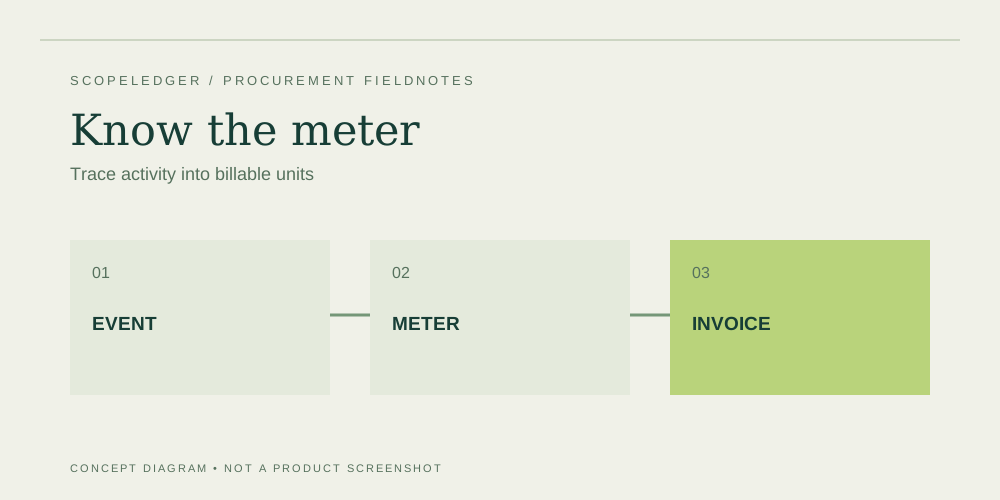
Ask for a sample usage report and invoice before purchase. You should be able to connect a business event to a measured unit and then to a charge. If the supplier cannot explain that chain, model the item as uncertain and assign a follow-up. Do not substitute another product's usage definition just because its documentation is easier to find.
Build a consumption inventory
| Item | Baseline to collect | Commercial detail |
|---|---|---|
| Document processing | Documents and pages by type | What counts, including failures |
| Integration platform | Runs, messages, and retries | Allowance and overage tiers |
| Storage | Records, attachments, retention | Capacity basis and growth charge |
| Test environments | Number, size, refresh frequency | Included versus additional |
| Automated features | Executions or relevant credits | Meter definition and controls |
Document whether the baseline is measured or assumed. A sample week may miss year-end processing, seasonal sales, or migration backfills. Record peaks separately from recurring volume. If the metric has no equivalent in the current system, run a bounded test with representative data and obtain an explanation of how the result translates into billing.
Model units before dollars
Consider an illustrative service with 10,000 included documents monthly and a fictional overage price of $0.04 per document. At 14,000 billable documents, the overage is (14,000 − 10,000) × $0.04 = $160 for that month. At the same volume every month it would be $1,920 annually. This is arithmetic only; it is not an actual ERP tariff or an assertion that documents are counted this way.
Now ask whether failed documents, retries, page counts, or test use alter the billable total. If the quote uses purchased blocks rather than simple overage, the formula changes. Round to the actual purchasing increment and show unused capacity separately. Do not use a smooth per-unit estimate to conceal the cost of a minimum block purchase.
Put controls where spend is created
Assign a budget owner and an operational owner. The operational owner should understand which workflows drive use and whether throttling or disabling them is safe. A hard spending cap might interrupt invoice processing or integration jobs, so its consequences need review. Alerts also need a response process; an email nobody owns is not a meaningful control.
Ask whether limits apply per tenant, environment, legal entity, or subscription. Check who can purchase extra capacity and whether automatic expansion is enabled. Record approvals for nonproduction use, bulk backfills, and automated retries. Where a usage feature touches financial or personal data, involve security and privacy owners as well as the person responsible for the bill.
Reconcile the model after launch
Compare the first actual usage report against the expected business volume. Investigate differences before revising the baseline. A higher count may reflect duplicate processing, an integration loop, or a misunderstood meter rather than genuine business growth. Keep the evidence so future budgets can distinguish a permanent operational requirement from a one-time migration event.
At renewal, review both the rate and the allowance. A stable headline price can still produce a higher bill if the included quantity changes or a discount ends. Archive the commercial definition that applied to each period. For complex metering, ask the supplier to validate your worked examples in writing and have a technical reviewer confirm that the system can produce the necessary measurements.
Approval worksheet
Choose an operational trigger for reviewing each meter. It might be an unexpected spike, a new automated process, a large historical import, or approaching an agreed allowance. Explain who investigates and whether the activity can safely be paused. Do not leave the decision solely to someone who sees the invoice after consumption has occurred.
At the first billing review, select one charged unit and trace it backward to the source event. Repeat the exercise for a failed or retried event if the product exposes that detail. Compare the observed count with the commercial definition and request clarification for differences. Archive the report and interpretation alongside the rate schedule. When business volume changes, update the forecast using the same definition. This helps separate genuine growth from technical noise and gives procurement evidence for discussing allowances or a different commercial arrangement at renewal.
FAQ
Are usage charges necessarily bad?
No. They can align spending with activity when the meter is understandable and controllable. The issue is whether your budget and operations can predict and manage the billable activity.
Can I assume sandbox use is free?
No. Ask which environments and capacities are included and whether tests consume the same allowance as production. Document the answer for migration rehearsals and integration load tests.
Should I reserve an arbitrary percentage for add-ons?
A contingency can expose uncertainty, but it should not replace an inventory. Estimate known meters from actual scope, then disclose remaining unknowns and the method used for any reserve.
Sources
- Microsoft Business Central pricing — check add-on references and current product details; the hypothetical meter above is unrelated to published terms.
Continue the workbook
- ERP software pricing comparison: build a like-for-like ledger
- Cloud ERP versus self-managed ERP: compare responsibilities
- ERP implementation costs: price deliverables and exclusions
Use the ERP total cost calculator for your own scenario, the quote readiness checklist to track evidence, and the cost structure comparison to review purchasing models.