Cloud ERP versus self-managed ERP: compare responsibilities
Compare cloud and self-managed ERP by operational ownership, environments, upgrade duties, recovery needs, and the costs assigned to your team.
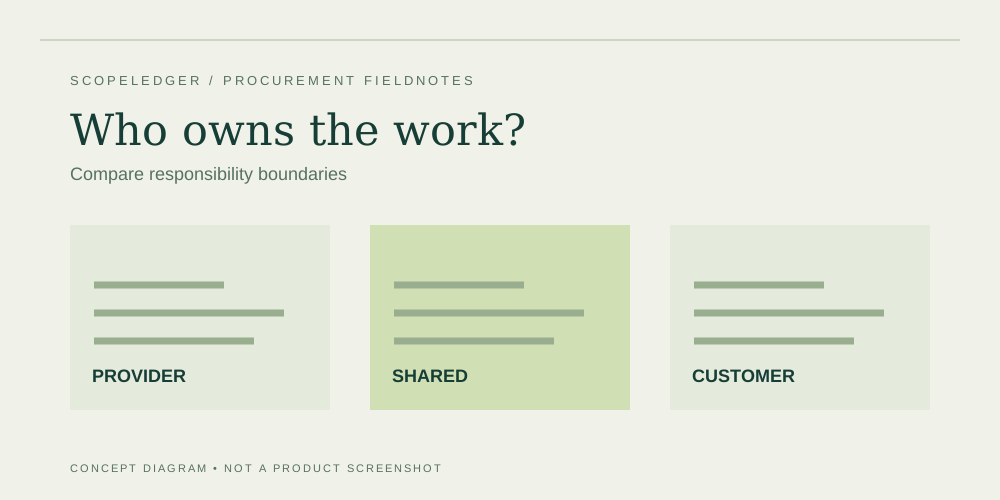
Compare cloud and self-managed ERP by who performs and pays for the work. A cloud subscription and a self-managed software license have different boundaries. Normalize infrastructure, security, backups, upgrades, environments, support, and application administration before concluding that one deployment has a lower cost.
Define the deployment choices precisely
“Cloud” can mean vendor-managed software, a partner-hosted instance, or an application your own team operates on rented infrastructure. Those arrangements do not transfer the same responsibilities. Ask who controls the application version, database, identity configuration, backup schedule, and recovery process. The answer should name a party and a deliverable, not simply say “managed.”
Self-managed also covers several arrangements. You might run the system in your own facility or use infrastructure services elsewhere. Either way, identify who patches the operating system, maintains the database, monitors capacity, renews certificates, and tests restoration. Ownership of infrastructure is not the same as operational capability. An inexpensive server estimate can omit most of the labor required to keep a business system usable.
Write a responsibility matrix
| Responsibility | Vendor-managed question | Self-managed question |
|---|---|---|
| Recovery | What can the customer restore and when? | Who maintains and tests backups? |
| Upgrades | What notice and test window are provided? | Who plans, tests, and installs releases? |
| Access | Which identity features are included? | Who runs identity and permissions? |
| Environments | How many sandboxes are included? | Who funds and refreshes them? |
| Support | Where does vendor support end? | Who owns infrastructure diagnosis? |
Use the matrix as an appendix to the budget. If a task is shared, describe the handoff. For example, a provider may restore a database while your team verifies business reconciliation. Without the second task, technical restoration can be mistaken for operational recovery. A task that has no owner should remain an unresolved risk, not an assumed saving.
Separate fixed costs from effort and consumption
An illustrative self-managed budget might include $9,000 annual infrastructure, $12,000 annual operations support, and a $6,000 upgrade exercise every three years. Over three years, those lines total $69,000 before software licensing and implementation. A competing cloud quote might include some of those services in its subscription while excluding business administration. These figures are teaching inputs, not typical ERP costs.
Avoid adding the full cost of an existing employee to one option while treating their work as free in the other. Estimate the additional work and capacity consumed by each choice. If the team already has infrastructure skills, that can affect feasibility, but it does not eliminate opportunity cost. Show cash expenditure and resource commitments separately, then explain how each influences the recommendation.
Ask about limits that appear after launch
Storage, test environments, integrations, audit retention, and automated processing may have limits. Request the included allowance, measurement basis, overage price, notification method, and ability to export usage history. A service that scales automatically can still require budget controls. For a self-managed design, check capacity and recovery architecture against realistic peaks rather than copying the average transaction volume.
Ask what customization is allowed and what happens during upgrades. Distinguish configuration supported by the product from custom code maintained by a partner. A deployment choice that enables customization may also place maintenance obligations on your team. Do not count customization as a benefit until the requirement, testing responsibility, and maintenance cost are explicit.
Decide using constraints, then compare cost
Some organizations have contractual, technical, or operational requirements that restrict available designs. Have qualified security and legal advisers evaluate those requirements rather than making broad claims that one deployment is automatically compliant or secure. Ask for evidence that applies to the service and region actually being purchased. A brand-level security statement is not a complete assessment of your configuration.
After eliminating infeasible designs, compare the remaining choices on the same horizon. Include transition, operational staffing, planned upgrades, and exit support. Consider how much operating responsibility the organization can reliably sustain. The least expensive theoretical architecture is not useful if nobody can perform its recovery procedures or keep its supported versions current.
Approval worksheet
Before selecting a deployment, hold a recovery tabletop exercise. Describe a realistic interruption and ask each named party what it does, what evidence it provides, and when the business can resume work. Include identity, integrations, restored records, user communication, and reconciliation. If participants cannot explain a handoff, update the responsibility matrix and price the missing work.
Then review a planned upgrade in the same way. Identify the test environment, regression scripts, application owners, scheduling constraints, rollback approach, and communication to users. Compare how each deployment handles those tasks rather than assuming automatic updates eliminate testing. Retain the exercise results with the budget. They make operational responsibilities concrete and help the buyer judge whether an apparently lower-cost arrangement is supported by real capacity. Revisit the matrix when a managed-service provider, internal team, or critical integration changes, because the original boundary may no longer match the operating model.
FAQ
Does cloud ERP eliminate IT administration?
No. It can shift infrastructure duties while leaving identity, permissions, integration, data quality, training, and application administration with the customer. Confirm each responsibility in the actual service agreement.
Is self-managed always more customizable?
Customization depends on the product, edition, deployment, and support terms. Ask for a supported design for your requirement and a written explanation of how updates affect that design.
How should existing infrastructure be valued?
Separate sunk spending from future cash needs and resource use. Existing equipment may still require maintenance, capacity, replacement, and staff effort. Ask finance to review the comparison method.
Sources
- Odoo pricing — verify current deployment and plan boundaries for that product directly.
- NIST Small Business Cybersecurity Corner — resources for reviewing security responsibilities with your technical team.
Continue the workbook
- ERP software pricing comparison: build a like-for-like ledger
- ERP implementation costs: price deliverables and exclusions
- ERP integration costs: budget beyond the connector
Use the ERP total cost calculator for your own scenario, the quote readiness checklist to track evidence, and the cost structure comparison to review purchasing models.