ERP implementation costs: price deliverables and exclusions
Break an ERP statement of work into configuration, migration, integration, training, testing, and cutover with clear acceptance criteria.
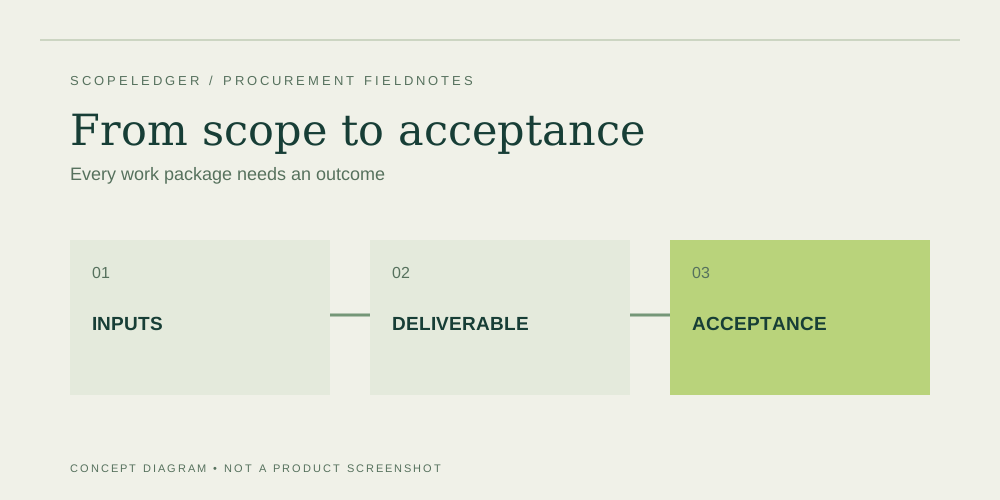
Price ERP implementation as a set of deliverables with acceptance criteria, not an unexplained percentage of subscription cost. Require the statement of work to identify what the partner does, what the buyer must provide, what is excluded, and how changes are charged. A fixed fee is only meaningful when the fixed scope is understandable.
Divide the work into accountable packages
Use discovery, design, configuration, migration, integrations, testing, training, cutover, and post-launch stabilization as initial headings. Then replace broad labels with observable outputs. A configuration package might include an approved chart of accounts, posting groups, approval rules, and tested tax setup. “Configure finance” is too vague to tell either side when the work is finished or whether a later request is additional scope.
For every package, name the supplier owner, buyer owner, inputs, output, and approval method. If the buyer must clean customer records, provide subject matter experts, or approve designs within a certain period, those are delivery dependencies. Schedule them and check capacity. An apparently inexpensive project can move substantial effort to the buyer without making that effort disappear.
Read fixed-fee assumptions as commercial terms
| Scope item | Example assumption to clarify | Why it changes cost |
|---|---|---|
| Data migration | One file format and two rehearsals | More formats or retries add work |
| Integrations | One direction and defined fields | Bidirectional exceptions need design |
| Reporting | Specified report layouts | New reporting logic expands scope |
| Training | Named groups and sessions | Repeated sessions use more time |
| Cutover | One location and one launch | Parallel launches increase coordination |
These are questions to ask, not claims about standard partner packages. Confirm the actual quantity and complexity in your proposal. An assumption that contradicts your operating reality should be resolved before signing, even if the price increases. Otherwise the apparent savings may become a later change request with less room to negotiate.
Compare billing approaches without picking a universal winner
A fixed-price package can make an agreed scope predictable while leaving exclusions and change control important. Time and materials makes consumed effort visible but requires rate cards, approvals, time records, and a forecast to complete. A capped arrangement needs a precise explanation of what happens at the cap. Does work stop, scope shrink, or the supplier absorb extra effort? The label alone answers none of those questions.
Ask for a milestone schedule that connects invoices to meaningful progress. A design approval is different from a working integration; both may be legitimate milestones if the contract explains them. Avoid using elapsed time as the only evidence of completion. Review payment and acceptance terms with procurement or counsel rather than assuming a demonstration gives you a right to withhold payment.
Build an illustrative delivery budget
Suppose a fictional proposal has $12,000 configuration, $8,000 migration, $6,000 integration, $4,000 training, and $5,000 cutover support. The stated delivery subtotal is $35,000. If a second migration rehearsal costs an additional illustrative $2,000 and travel is budgeted at $1,500, the modeled project cash cost is $38,500. This example does not estimate a typical ERP project; it shows how exclusions should enter the comparison.
Buyer resources remain separate. If finance staff need 120 hours for mapping and reconciliation, the project plan must reserve those hours. A business case may value them at an internal rate, but that is not automatically incremental cash spending. Keep supplier invoices, incremental internal spending, and allocated staff effort distinct so decision makers can see both cash and capacity needs.
Agree change control while the relationship is calm
Require a change request to explain the requirement, reason, alternatives, cost, schedule effect, and acceptance test. Name who can authorize changes. A helpful consultant should not be able to commit the buyer to additional fees through an informal conversation with an employee who has no purchasing authority. Equally, the buyer should not expect unpriced new scope simply because it emerged during testing.
Review unresolved design decisions before each milestone. If a core workflow remains uncertain, identify a bounded discovery task to resolve it rather than covering uncertainty with a large undocumented allowance. Consider a limited discovery phase before the main implementation where the requirements are immature. Have project and legal advisers assess whether the resulting documents give enough clarity for the commercial commitment being made.
Approval worksheet
At the final scope review, choose one deliverable from each workstream and ask both parties to describe what completion means. The answers should agree on outputs, buyer inputs, acceptance evidence, and responsibility for correcting a failed test. If they do not, revise the description while negotiation remains practical. Do not rely on a broad project objective to settle a detailed delivery disagreement.
Reconcile the milestone invoices with the work plan and cash forecast. Identify which approvals require scarce buyer resources and reserve their time. Check that dependencies on publishers, third-party applications, and hardware have owners outside the implementation partner where needed. Retain a forecast-to-complete view even for a fixed-fee project, because buyer effort and separately priced exclusions can change. The sponsor should understand the remaining work and total expected commitment, not merely the percentage of partner invoices paid.
FAQ
Should implementation be a multiple of annual software cost?
That shortcut hides scope. Request a task-based estimate and documented assumptions. Subscription spend and delivery effort can move independently, especially when data, integrations, or organizational changes dominate the work.
Does a fixed price remove overrun risk?
No. It can fix the price of specified work while leaving exclusions, buyer delays, change requests, and scope disputes. Read the assumptions and remedies as closely as the fee schedule.
What is the most useful final deliverable?
A working, accepted process supported by documentation and accountable owners. Technical configuration without trained users, reconciled records, and a workable support route is not the full operational result.
Sources
- Microsoft Business Central pricing — the official page directs buyers to partners for assessments and additional pricing; it does not price this illustrative project.
Continue the workbook
- ERP software pricing comparison: build a like-for-like ledger
- Cloud ERP versus self-managed ERP: compare responsibilities
- ERP integration costs: budget beyond the connector
Use the ERP total cost calculator for your own scenario, the quote readiness checklist to track evidence, and the cost structure comparison to review purchasing models.