ERP renewal costs: separate uplift, scope, and commitment
Read an ERP renewal notice by isolating price changes, additional scope, term commitments, and the deadline for reducing or canceling services.
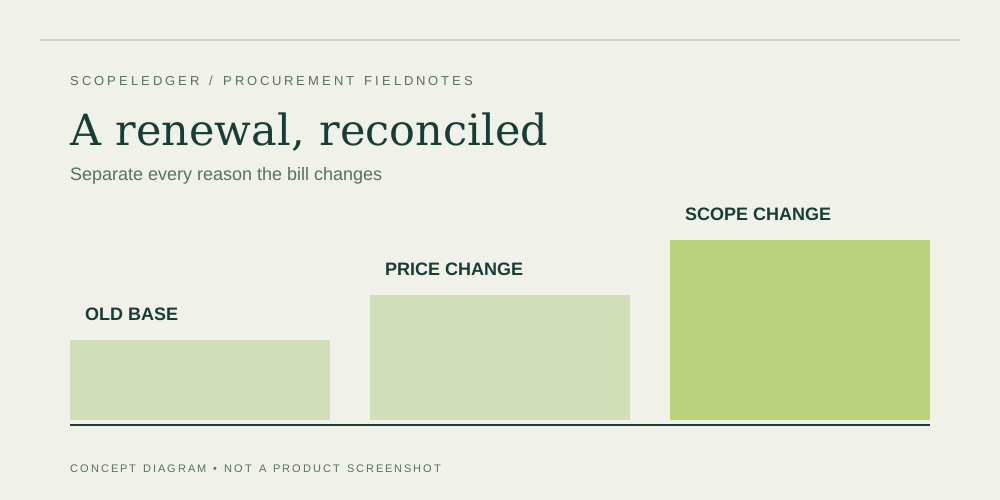
An ERP renewal comparison should isolate three things: the price of unchanged scope, the cost of new scope, and the commitment you are making for the next term. Check notice deadlines and reduction rights before negotiating. A quoted percentage increase does not explain the whole change in the invoice if user counts, modules, usage, or discounts also change.
Reconstruct the current agreement
Collect the signed order form, amendments, renewal notices, invoices, and applicable service terms. Identify the legal supplier for each line: the software publisher, reseller, implementation partner, and integration provider may have separate agreements. Put their renewal dates on one calendar. Do not assume a cancellation notice sent to one party ends every connected service.
Record current quantities, contracted unit prices, discounts, payment cadence, minimum commitments, and remaining term. Distinguish an annual subscription billed monthly from a genuinely monthly commitment. The cash schedule can look similar while the cancellation obligation differs. Ask procurement or counsel to interpret ambiguous provisions before your negotiation window closes.
Build a renewal bridge
| Change | How to calculate | Evidence |
|---|---|---|
| Same-scope uplift | Existing charge × stated increase | Notice and pricing clause |
| Added users | New quantity × applicable rate | Approved roster and quote |
| Added modules | New module charge | Scope and dependency list |
| Discount expiry | Undiscounted less discounted price | Promotion or order form |
| Usage adjustment | Billable units × relevant rate | Usage export and rate schedule |
A renewal bridge explains the movement from the old annual amount to the proposed amount. Ask the supplier to reconcile every line. A price increase described as “only five percent” can coexist with a much larger total increase caused by scope or an expiring discount. Conversely, a higher user count may explain a larger bill without a change to the underlying unit price.
Work an illustrative example
Assume a fictional current subscription of $24,000 annually. A proposed 5% uplift adds $1,200. Additional modules add $3,000 annually, and a one-time transition charge adds $1,000 in the next year. Next-year modeled cash is $24,000 + $1,200 + $3,000 + $1,000 = $29,200. The recurring run rate is $28,200 if no other recurring line changes. None of these inputs is a published ERP renewal benchmark.
For a multi-year scenario, decide whether the uplift applies once or compounds each year, and which lines it applies to. An illustrative 5% annual increase on an unchanged $24,000 base produces $25,200 in the next year and $26,460 in the following year. Do not compound an implementation fee or a price-protected line simply because it appears on the same invoice.
Negotiate around your actual flexibility
Before requesting a discount, determine what you can change. Can unused seats be removed at renewal? Can a module be dropped without losing a required dependency? Can the term be shortened? Is a multi-year commitment offering a price cap, a fixed unit price, or merely a first-year discount? Write the proposed tradeoff in plain language and compare its total obligation.
Avoid accepting additional seats you do not need merely to reach a nominal discount band. Compare the final committed amount and the operational value of the scope. A lower unit price with a larger minimum can increase spending. Request any price protection, reduction right, and notice exception in the signed commercial documents rather than leaving them in a sales email thread.
Preserve time for a real alternative
Renewal leverage is limited if there is no time to assess a transition. Maintain an exit inventory even when you expect to stay: exported data, integration dependencies, user processes, and partner handover requirements. The cost of switching should include internal effort, parallel operations, training, and reconciliation. Do not compare one year's renewal invoice against only the first month of a replacement subscription.
Escalate material contract questions to counsel and budget commitments to finance. The purpose of the renewal workbook is to expose the commercial decision, not to interpret legal rights automatically. If negotiations continue near a notice deadline, confirm in writing whether that deadline has changed. A friendly ongoing discussion is not evidence that an obligation has been waived.
Approval worksheet
Prepare a renewal calendar that begins early enough for your own approval and alternative evaluation process. Work backward from the actual notice and commitment dates rather than selecting an arbitrary industry timetable. Assign the person who obtains the renewal quote, reconciles usage, reviews scope, checks contractual provisions, and signs the final order. Record absences and delegated authority where deadlines are material.
Before acceptance, compare the final documents with the negotiated bridge. Check quantities, term, price protection, reduction rights, payment cadence, and any separate partner services. Save the approved version and remove obsolete working totals from circulation. After the first renewal invoice, reconcile it against the signed order rather than assuming implementation of the agreement is automatic. This final check can reveal a billing setup error, a misunderstood effective date, or a missing credit while the supporting documents and responsible people are still readily available.
FAQ
Does a renewal increase have to match inflation?
Do not assume that. The applicable contract and law determine the rights and restrictions. Ask your legal adviser to review the provision and compare the notice with the signed agreement.
Should new users receive the same rate?
That depends on the agreement. Ask which price applies, whether proration is available, and whether added users inherit the existing renewal date or create another commitment.
Can I use the calculator as an invoice check?
Use it for arithmetic on a defined scenario. It does not interpret discounts, taxes, proration, or contractual permissions. Reconcile the final invoice line by line against the relevant documents.
Sources
- Microsoft Business Central pricing — verify current public payment descriptions; your own order form controls the renewal scenario.
Continue the workbook
- ERP software pricing comparison: build a like-for-like ledger
- Cloud ERP versus self-managed ERP: compare responsibilities
- ERP implementation costs: price deliverables and exclusions
Use the ERP total cost calculator for your own scenario, the quote readiness checklist to track evidence, and the cost structure comparison to review purchasing models.