Phased ERP rollout versus one launch: compare the real cost
Compare phased and single-launch ERP plans by temporary interfaces, parallel operations, training effort, reconciliation, and cutover risk.
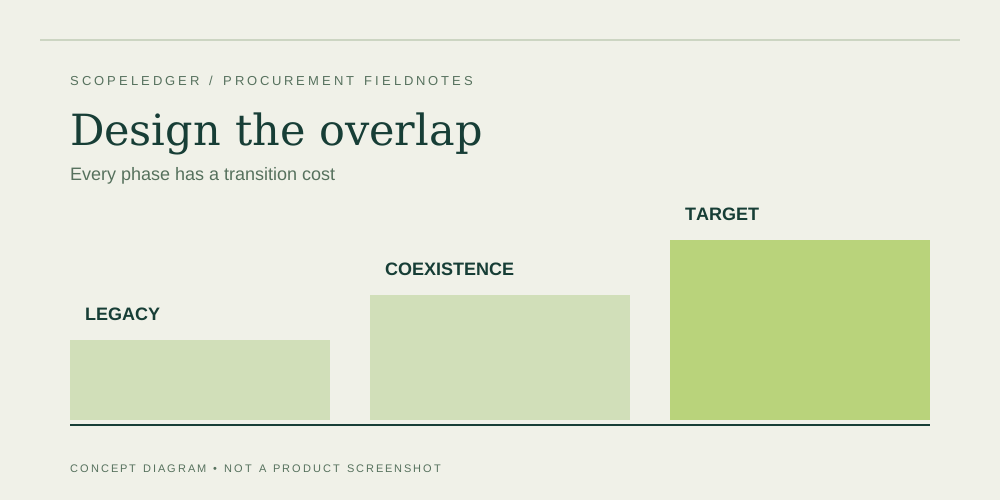
Compare phased and single-launch ERP plans by the temporary operating model each requires. Phasing can reduce the amount changed at once while extending coexistence, interfaces, and repeated training. A single launch can shorten that overlap while concentrating readiness and recovery demands. Neither approach is automatically cheaper or safer for every organization.
Choose a phase boundary the business can operate
Possible boundaries include legal entity, location, process, or user group. Each leaves different transactions crossing between old and new systems. A location-based rollout may require intercompany flows between platforms; a finance-first rollout may need temporary interfaces from legacy operations. Map those crossings before assuming that splitting the project creates independent, simpler pieces.
Identify the system of record during each phase. Explain where customers, items, prices, inventory, and financial balances are maintained. If the same record is edited in two systems, define synchronization and conflict handling. Temporary manual procedures also need controls and owners. A phase is only practical if the business can explain how a transaction completes from beginning to end while the systems coexist.
Build a transition cost inventory
| Transition cost | Phased-plan question | Single-launch question |
|---|---|---|
| Temporary interfaces | Which bridges are built and later retired? | What final interfaces must work immediately? |
| Parallel operations | How long are both systems supported? | Is a short validation overlap planned? |
| Training | How many repeated groups or refreshes? | Can all users train before launch? |
| Reconciliation | How are cross-system records matched? | Can opening records be approved in time? |
| Support | Is stabilization repeated per phase? | Is enough concentrated support available? |
Keep transition cost separate from the steady-state subscription. A phased plan may postpone some license activations, but confirm minimum commitments and purchasing terms. Do not assume the supplier bills precisely according to your operational phase schedule. The procurement documents and implementation plan must agree on activation, environment, and support timing.
Work an illustrative overlap example
Suppose a phased plan keeps the legacy service for six extra months at a fictional $2,000 monthly and needs a temporary interface costing $7,000. Those two transition lines add $19,000 before training or internal effort. If staged licenses save an illustrative $9,000 during the same period, the net of those selected lines is $10,000 additional cost. This is not a total project comparison or a forecast of typical phasing costs.
The additional cost might still be justified if the plan fits staffing or reduces an unacceptable launch constraint. Conversely, a single launch may require extra rehearsal, external support, or a planned operational pause. State the consequence and decision criterion. Do not attach an invented monetary value to disruption merely to produce a precise return calculation.
Establish readiness and stopping rules
For each phase or launch, define migration reconciliation, critical test results, user access, training completion evidence, support readiness, and recovery procedures. Name who approves each condition. A calendar date is a constraint, not proof of readiness. If a condition is waived, document the owner, consequence, compensating procedure, and deadline for resolution.
Rehearse the cutover with realistic sequencing and resources. Test what happens when a load takes longer than expected, a key person is unavailable, or a reconciliation fails. A stopping rule should tell the team when to delay, when to revert, and how to handle transactions created during the attempt. Have technical and business owners validate the procedure together.
Retire temporary work deliberately
Phased projects can leave temporary interfaces and spreadsheets in place because nobody owns their removal. Add retirement tasks to the plan, including reconciliation, access removal, documentation updates, and vendor cancellation. The end of the final phase should produce a supported operating model rather than a collection of bridges whose purpose is no longer clear.
Review the rollout recommendation alongside team capacity, operational peaks, financial close, and supplier commitments. The decision should explain why the chosen boundary is manageable and which evidence supports it. Use a project manager and relevant technical specialists to validate the detailed sequence. The cost comparison informs that decision; it does not replace operational readiness or recovery judgment.
Approval worksheet
For each proposed phase, write a day-in-the-life transaction that crosses its boundary. Follow the customer order, item movement, payment, or financial posting through both systems. Identify duplicate entry, timing gaps, reconciliation work, and the person responsible for each handoff. If the team cannot explain the complete transaction, the phase boundary needs further design before it is used as a budget assumption.
Schedule a formal decision before starting the next phase. Review actual support demand, unresolved defects, data quality, buyer capacity, and the continued validity of the remaining plan. Carry lessons into the next cutover rather than repeating an unchanged checklist. Update transition costs when coexistence lasts longer or a temporary interface must be extended. Keep the sponsor informed of the total remaining commitment, including legacy services, so a delayed phase does not create invisible recurring spend outside the project budget.
FAQ
Does phasing always lower risk?
No. It can reduce the scope of one launch while creating coexistence and reconciliation risks. Assess the actual process boundaries, temporary controls, and the organization's ability to sustain a longer transition.
Can we save licenses by activating them later?
Possibly, subject to the quote and contract. Ask about minimum commitments, activation dates, environment rights, and proration. Do not count a saving until the commercial terms support it.
What should happen after each phase?
Review defects, support load, data quality, and lessons before proceeding. Confirm that the next phase's assumptions still hold. Retire temporary procedures when their purpose ends and retain the relevant evidence.
Sources
- NIST Small Business Cybersecurity Corner — consult security planning resources for transition access and recovery responsibilities.
Continue the workbook
- ERP buying checklist: from requirements to approval
- ERP business case: separate cash savings from capacity
- ERP demo checklist: test workflows instead of slides
Use the ERP total cost calculator for your own scenario, the quote readiness checklist to track evidence, and the cost structure comparison to review purchasing models.