ERP data migration budget: clean, rehearse, reconcile
Plan ERP migration around data ownership, cleanup, mapping, rehearsal loads, reconciliation, and the evidence needed to approve opening balances.
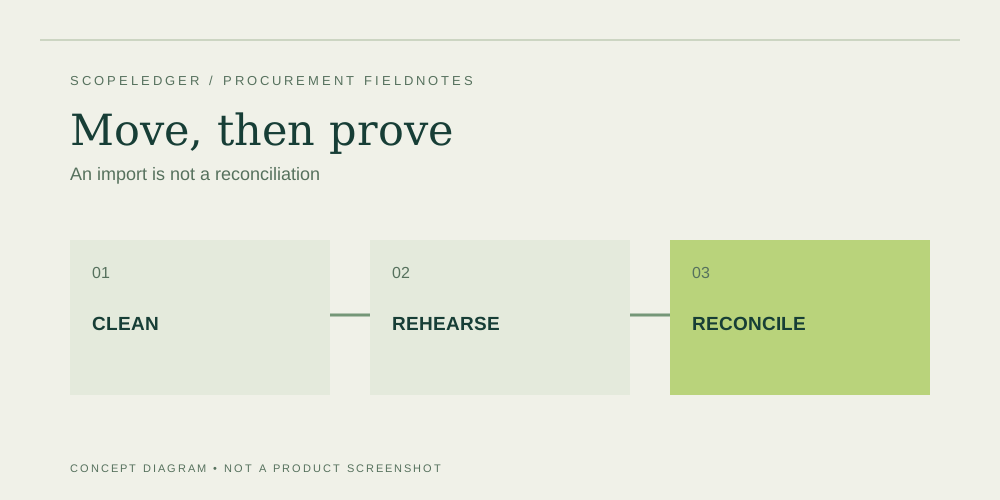
Budget ERP data migration as a controlled business workstream: decide what to move, clean and map it, rehearse the load, reconcile the result, and approve the opening position. “Migration included” is not enough. The statement of work should name data sets, formats, history depth, responsibilities, load attempts, and acceptance evidence.
Decide what belongs in the new system
Separate master data, opening balances, open transactions, attachments, and historical detail. They have different purposes and validation needs. A new ERP may need active suppliers and open purchase orders while older detail remains in a controlled archive. That choice should follow reporting, operational, audit, and retention requirements rather than a desire to copy everything simply because it exists.
Ask finance, legal, privacy, and operational owners about the records they need and the format in which they must remain accessible. Do not use a generic retention period from an unrelated business. Determine which system remains authoritative for history and how users will retrieve it after the old application is retired. A migration scope that excludes history needs a workable archive plan, not just fewer rows to load.
Assign data ownership before mapping
| Data set | Business owner | Acceptance evidence |
|---|---|---|
| Customers and suppliers | Commercial and finance leads | Duplicates and required fields reviewed |
| Items | Operations lead | Units, categories, and costing setup approved |
| Opening balances | Controller | Reconciliation to approved source totals |
| Open orders | Process owners | Status and remaining quantities checked |
| Attachments | Records owner | Linked files accessible with permissions |
The implementation partner can transform files but should not silently decide which supplier is genuine, which stock unit is correct, or how an unresolved balance should be classified. Those are business decisions. Name an owner for each exception and keep a decision record. The budget must include time for those owners to resolve problems between rehearsal loads.
Scope rehearsals as learning cycles
Specify what each rehearsal is intended to prove. An early load may validate mapping and field requirements. A later rehearsal should use cleaned records, production-like permissions, and a cutover sequence. Measure elapsed time, rejected records, manual corrections, and reconciliation effort. A successful import message only proves that the loader accepted something; it does not prove that the business records are correct.
For illustration, suppose extraction and mapping cost $4,000, two rehearsal loads cost $2,000 each, and final cutover support costs $3,000. The external subtotal is $11,000. If internal cleanup takes 80 hours, show that resource commitment separately. These figures are fictional inputs. A third rehearsal might be necessary, but its cost should come from the agreed change process rather than an invented universal percentage.
Design reconciliation before the first load
For financial data, have the controller define source totals, target totals, tolerances, exceptions, and sign-off. For operational records, use quantities, statuses, counts, and selected record-level checks as appropriate. Totals alone can hide offsetting errors, so use a combination of aggregate and detailed tests. Preserve a record linking the source extract, transformation version, load, and validation results.
Protect sensitive migration files. Agree where they are stored, who can access them, how transfers occur, and when unnecessary copies are removed. Test data may need anonymization or other controls. Use security and privacy advisers for your organization's requirements. A lower migration quote is not a saving if it depends on uncontrolled copies of customer or employee records.
Make final cutover a repeatable procedure
Document the freeze, final extract, transformation, load, validation, approval, and release to users. Name the person who can stop the launch if reconciliation fails. Define what happens to transactions entered after the extract and how the team avoids posting them twice. A rollback plan must explain the business records and work performed during the attempted cutover, not only how to restore a database.
Retain the approved mapping and reconciliation evidence after launch. It helps investigate opening-balance questions, integration issues, and reports that differ from the legacy system. Have the business owners sign the final results and record outstanding exceptions with an owner and resolution plan. The migration budget has achieved its purpose when it funds a verifiable starting position, not merely an import utility run.
Approval worksheet
Before the final migration rehearsal, confirm that cleanup decisions have reached the source files and mapping rules. A correction made manually in the rehearsal target can disappear at the next load if the underlying cause remains. Maintain an exception log that identifies the responsible data owner, decision, correction location, and evidence that the corrected record survives a rerun.
Ask an independent business reviewer to inspect selected records and reconciliation totals. Include unusual cases rather than only familiar examples. Confirm that the final extract process can be repeated inside the cutover window and that authorized people can approve results when needed. If the plan relies on one specialist, document a backup and the relevant procedure. After launch, preserve the approved source snapshot and validation evidence according to the organization's retention and security requirements so questions about opening records can be investigated without recreating the migration.
FAQ
Must all historical transactions be migrated?
No universal rule applies. Decide based on operational, reporting, legal, and retention requirements. An archive may be appropriate, but it must remain usable and controlled for the people who need it.
Is data cleanup the partner's job?
Only if the scope says so, and business decisions still require buyer ownership. Separate technical transformation from deciding which records and values are correct. Budget time for both.
How many rehearsals are enough?
Use evidence rather than a fixed count. Continue until the agreed load, timing, reconciliation, and exception criteria are met. Price included attempts and additional support before depending on them.
Sources
- NIST Small Business Cybersecurity Corner — resources for handling migration access and security questions with your own team.
Continue the workbook
- ERP buying checklist: from requirements to approval
- ERP business case: separate cash savings from capacity
- ERP demo checklist: test workflows instead of slides
Use the ERP total cost calculator for your own scenario, the quote readiness checklist to track evidence, and the cost structure comparison to review purchasing models.